Monday
The blocks to read first
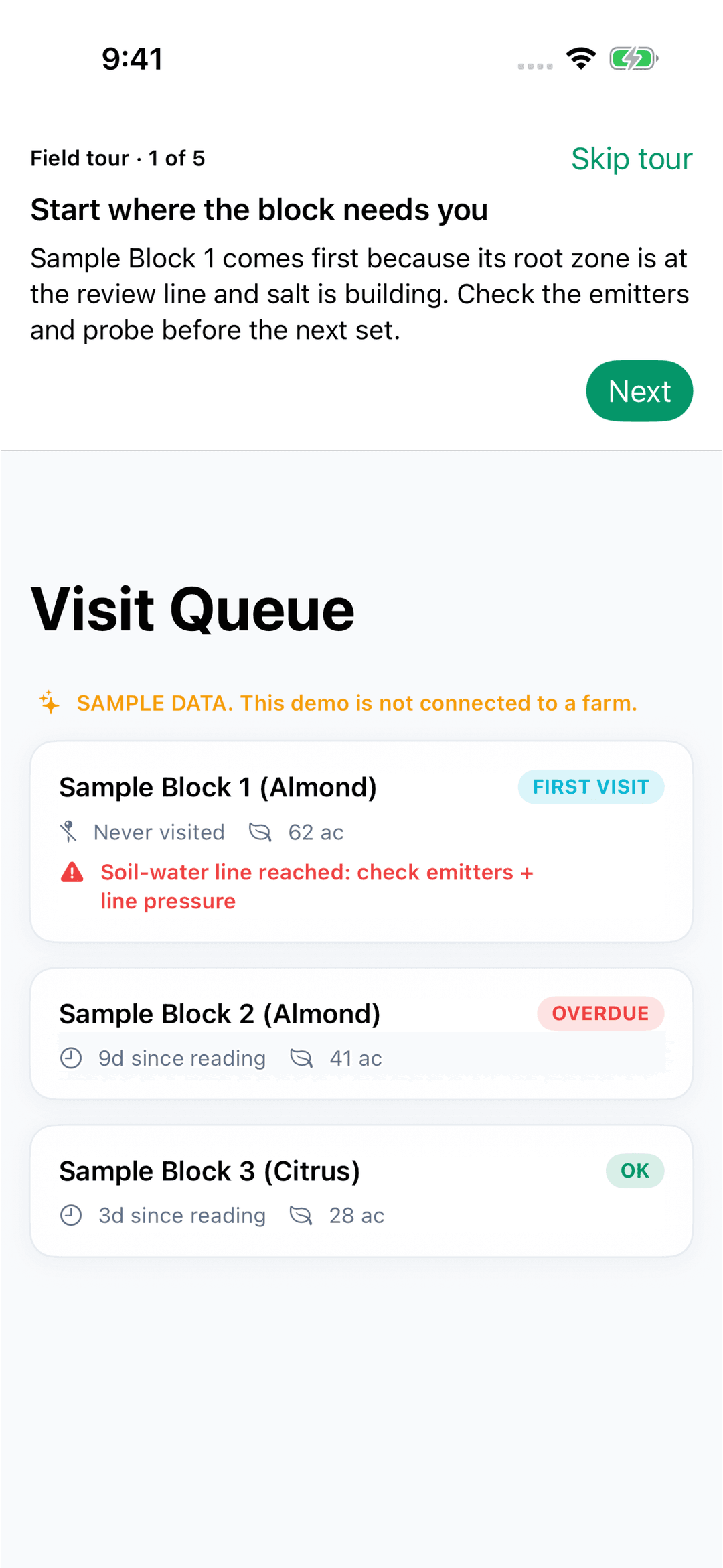
Every Monday, see which blocks to read first, why each is on the list, and the reading history behind it.
Every Monday, see which blocks to read first, why each is on the list, and the reading history behind it.
Our models draw on years of stem water potential (SWP) readings matched to the same blocks’ soil probes and weather.
Follow a sample week from the ranked queue through stem water potential (SWP) readings to the reviewed water order. The work log keeps the visit and decision together for the grower.
Platform is $20 per acre per year, with a 20-acre minimum.
Monday
Every Monday, see which blocks to read first, why each is on the list, and the reading history behind it.
Your crew
Your crew takes the readings and you make the irrigation call.
Thursday
Review a Monday briefing, and a Thursday draft water order where our agronomist’s past orders for a block are loaded into the draft’s rules, alongside your crew’s readings. You keep the irrigation call.
Your grower
The work log keeps the visit and decision together for the grower.
Our agronomist took the SWP readings these stress models learned from. The stress models have not beaten the simple rules a grower already has, such as the block’s latest SWP reading. Tested against the trees, not against another model.
Deep-stress block-weeks a shorter round would have left unread in their week: about 20 with a fixed rotation and 3 with the Monday list, of 102, at the same number of SWP readings. A careful crew sorting last week’s SWP readings by hand would have left about as many as the list.
Smarter rotations that ignore the readings closed most of the gap. Counts this small do not separate these orders. On the shorter round the list reached about 11% more stressed blocks per reading than a fixed rotation and somewhat more than the strongest rotation that ignores the readings, counting a block as reached when it is read in the week it is stressed or early the next. It was level with a careful hand sort. The list does that kind of sorting every Monday, for every block. Over a full week a plain rotation catches at least as many.
stem water potential (SWP) readings (through Oct 6, 2026).
of them on blocks with their own soil probe logging that day.
Replay on our longest-running orchard’s past seasons, 2023 to 2025, the orchard the list was developed on, on a shorter round. The crew read every one of these blocks in its week, nearly all by midweek; the replay asks which a shorter round would reach. Half of the 102 sit on three blocks. These figures are the replay’s. The list in service sets the stress line another way, so fewer block-weeks count as stressed and too few as severely stressed to compare orders. Scored its own way, it again reached more stressed blocks in their week than a fixed rotation and was not separated from a careful hand sort or from the strongest rotation that ignores the readings. Scored on the block-weeks the replay counts as stressed, its lead over a fixed rotation was smaller. Deficit-trial rows excluded. Development result, not a field trial. The adviser makes every call. Methods, plans and figures are available in diligence. This result comes from one citrus estate, the one the list was developed on. It has not yet been shown on another farm.
The stress models are trained on our own stem water potential (SWP) readings matched to soil probes and weather.
Your readings become a signed record your growers can show their GSA. The signing method is patent-pending.
Probe readings are sealed once each logger day closes; well-meter readings from telemetry are sealed as they arrive, checked every 10 minutes. Each issued water order is kept with the readings behind it; the order itself is not signed.
Probe readings, and well-meter readings that reach us through telemetry, are sealed into a signed record that is tamper-evident from signing forward; it does not show that a measurement was accurate or that a regulator accepted it.
The technology is patent-pending. No patent has been granted.
A trained model projects each probe’s soil moisture three days ahead if no irrigation or rain occurs. On a second farm never used in fitting, for probes with their own history, its three-day projection in periods when the probe saw no wetting was closer than every plain rule we tested, in the test plan and after it: its miss was about seven tenths of the best plain rule’s. For a brand-new probe with no history (tested on established probes shown none of their history) a plain rule does as well or better.
Only periods when the probe saw no wetting, on one farm and one probe make, and not a fresh blind test: that ground had been scored before. With that farm’s locations weighted equally, the model’s lead over the best plain rule is not clear. With irrigated periods removed the lead held; most remaining periods could not be checked, and on checked dry ones it is unclear. On the checked dry periods the lead is in the top 60 centimeters; deeper down, a plain rule does as well. Its printed range can be too narrow on ground it was not fitted on. The first forward score is November 23, 2026. It is a projection, not a call to irrigate.
On a new farm, your adviser weighs the model estimates against local readings. SWP readings, when available, are judged against the block's stress line.
SWP readings are optional to start. When you or your clients take one, it is judged against its block’s stress line. Every SWP reading you take sharpens the Monday list and the block’s record.
You keep your clients and your judgment. The app carries your queue, your crew’s readings and your issued order.
We prepare your growers’ EQIP practice 449 packets at no cost; each grower files as the applicant.
Take the guided field tour on your iPhone. No sign-in needed.
Sample data
Get the iPhone appTalk through your queue, your stem water potential (SWP) readings and how you make the call.