
See your water use against your groundwater allocation.
Irrigation decision software for California almond, pistachio and citrus growers and their crop advisers. Each week, a Monday briefing and a Thursday draft water order. Your adviser makes the call.
Platform: $20 per acre per year on your own probes. Keep your agronomist.Managed: $80 per acre per year with our sensors, crew and agronomist.
Works with Sentek, METER, Irrometer and AquaSpy probes, and CIMIS weather.
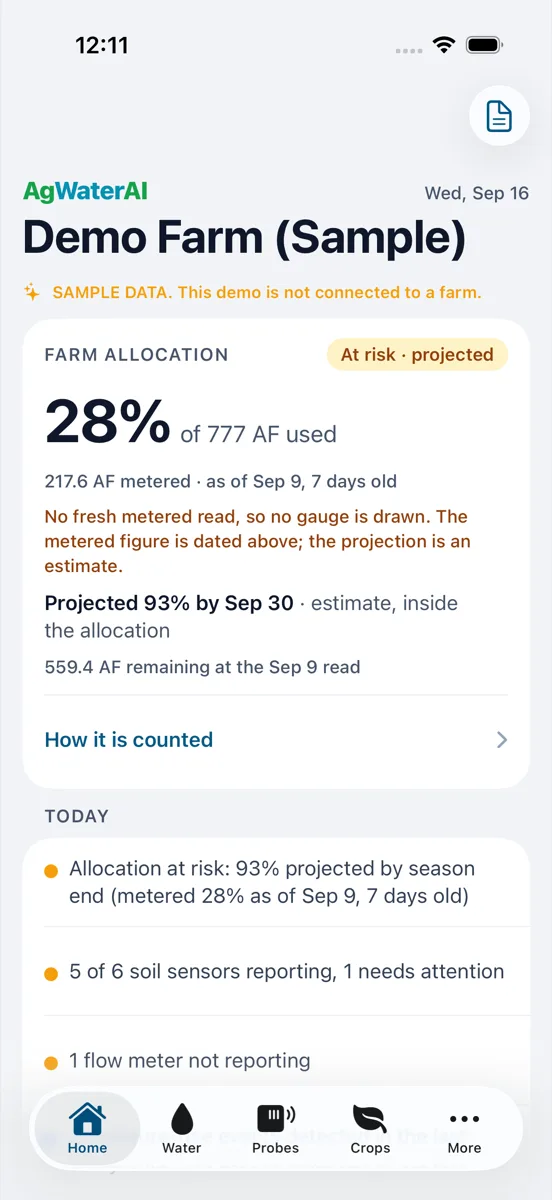
- Your allocation, every week
- Water used against the GSA allocation, with the metered figure dated and the projection labeled an estimate.
- Your adviser makes the call
- A Thursday draft water order per block. You or your adviser edit it and issue it.
- Readings on the record
- Reading summaries are signed, tamper-evident from signing forward, and each issued order is kept with the readings behind it.
Sample dashboard
Water use against the allocation, probes, meters and the latest readings, on a sample farm.
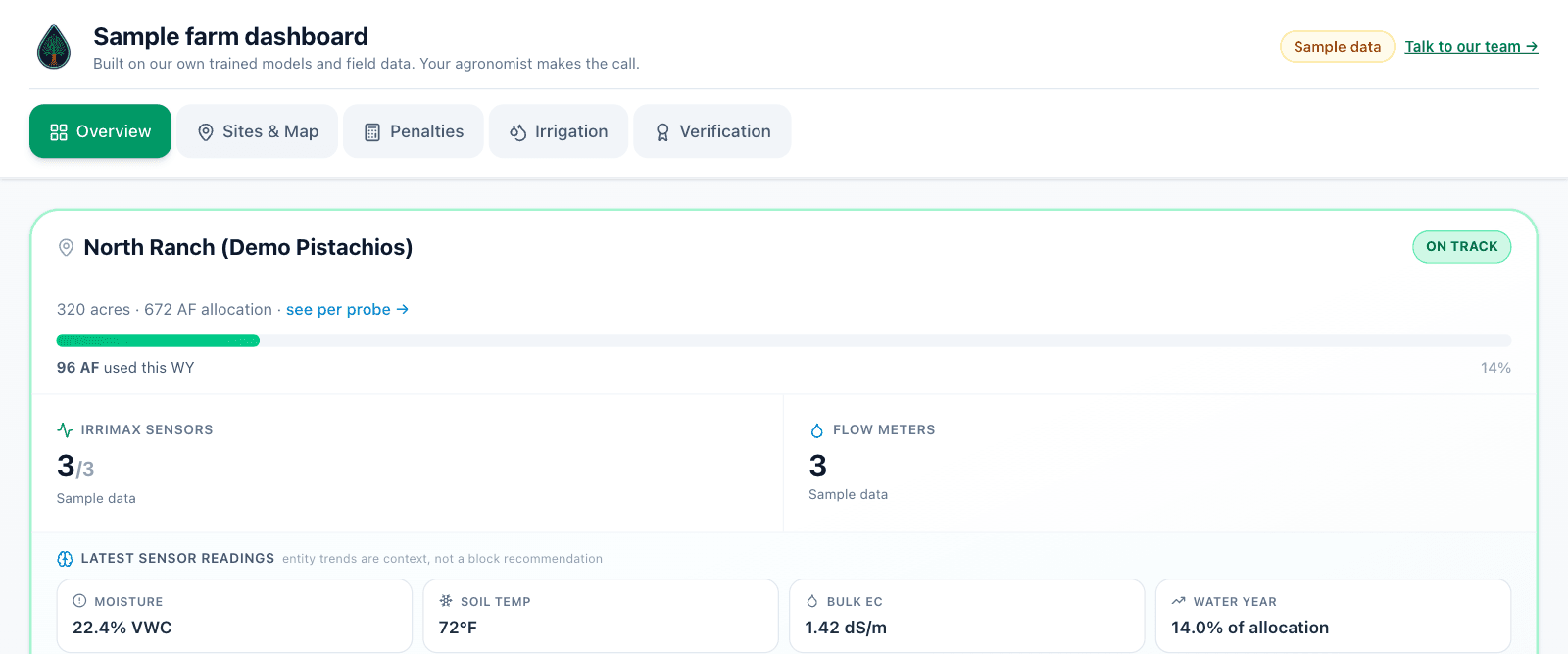
Farm allocation
96 AFof 672 AF used this water year
Metered through Oct 1, 2026
EstimateProjected 130 AF by Sep 30, inside the allocation
Block 06 · probe NR-1
- Moisture
- Above the block’s line
- Root-zone salt
- 1.42 dS/m, flushing
- Soil temp
- 72 F
- Last pressure chamber reading
- 12.5 bars, Fri
Groundwater program, in development
Sponsors fund the sensors on your orchard. You get a share for the groundwater you don’t pump.
Companies with water replenishment goals will fund sensors and monitoring on California orchards. Pumping will be metered where qualifying wellhead meters are in place, with other values labelled by source; pressure chamber readings document tree water status, not pumped volume. An independent validator reviews the calculation before any validated volume is claimed.
Benchmark efficiency
Available nowThe farm’s own season of water beside the published figure for the same crop and county, on the same basis, with its source stated.
Sample dataA comparison with a published figureEfficiency against a published benchmark, for the farm's own fields. A performance claim, not a reduction.
Measured reduction
2027 seasonProposed for the 2027 season: acre-feet pumped below an accepted site-specific baseline, metered where qualifying wellhead meters are in place, calculated and signed by AgWaterAI.
Sample dataMeasured, not independently validatedMeasured reduction against the farm's own weather-adjusted history. Measured and signed by AgWaterAI, not independently validated.
Validated benefit
2027 vintage, validation after the seasonThe same record reviewed by an independent assurance provider under an accepted method; the allocation cap is our proposal, subject to that review.
Independent validator named on the recordVWBA 2.0
Validator named on the record
Validated volumetric benefit under VWBA 2.0, baseline capped at the allocation, independent validator named.
Program status, October 2026
This program is being set up. No sponsor has signed, no volume has been independently validated, no independent validator is appointed yet, and no methodology has been approved. An independent pre-validation review has been requested.
The five steps, the grower share and the conditions are on the program pages.
A Monday briefing. A Thursday draft. Your adviser makes the call.
Monday
The briefing.
A written email before the week starts: blocks at or under the moisture line, the pressure chamber watch and the ETo outlook.
Thursday
The draft water order.
Sets, pump hours and days per block, with the reason, by email and in the app. It comes from the water balance on the farm's own probes, pump and CIMIS.
Your adviser
Reviews and issues it.
You or your adviser edit the draft and issue it, and both the draft and the issued order are kept with the readings behind them. On Managed, our agronomist reviews and issues every order.
Alerts flag a missed set, a dry and overdue block, or a probe that has gone quiet, once your records are connected.
| Block | Sets | Pump hours, week total | Days | Why |
|---|---|---|---|---|
| Citrus Block 02 | 2 sets | 14 h | Tue, Fri | Probe 24 in. trending down |
| Citrus Block 04 | 2 sets | 12 h | Mon, Thu | Pressure chamber reading 12.5 bars Fri |
| Pistachio Block 06 | hold | 0 h | adviser review | Review the field readings before scheduling water. |
| Mandarin Block 03 | hold | 0 h | recheck Thu | Depletion line 4 days out |
Citrus Block 02
2 sets · 14 h for the week · Tue, Fri
Probe 24 in. trending down
Citrus Block 04
2 sets · 12 h for the week · Mon, Thu
Pressure chamber reading 12.5 bars Fri
Pistachio Block 06
hold · 0 h for the week · adviser review
Review the field readings before scheduling water.
Mandarin Block 03
hold · 0 h for the week · recheck Thu
Depletion line 4 days out
The same week, in 50 seconds.
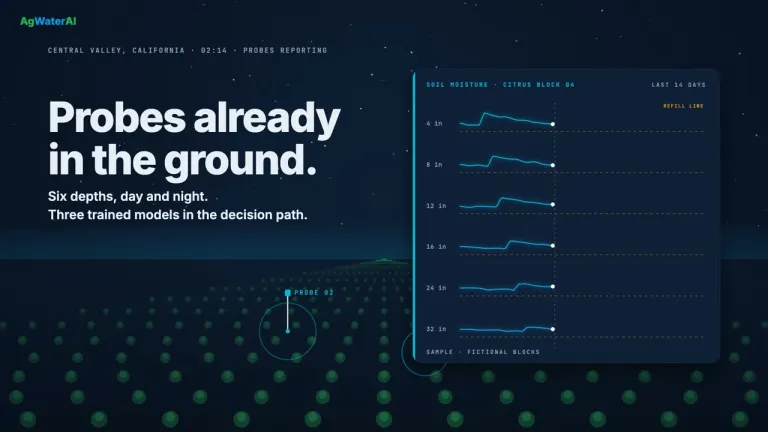
50 secondsSample dataCaptions on
On your phone
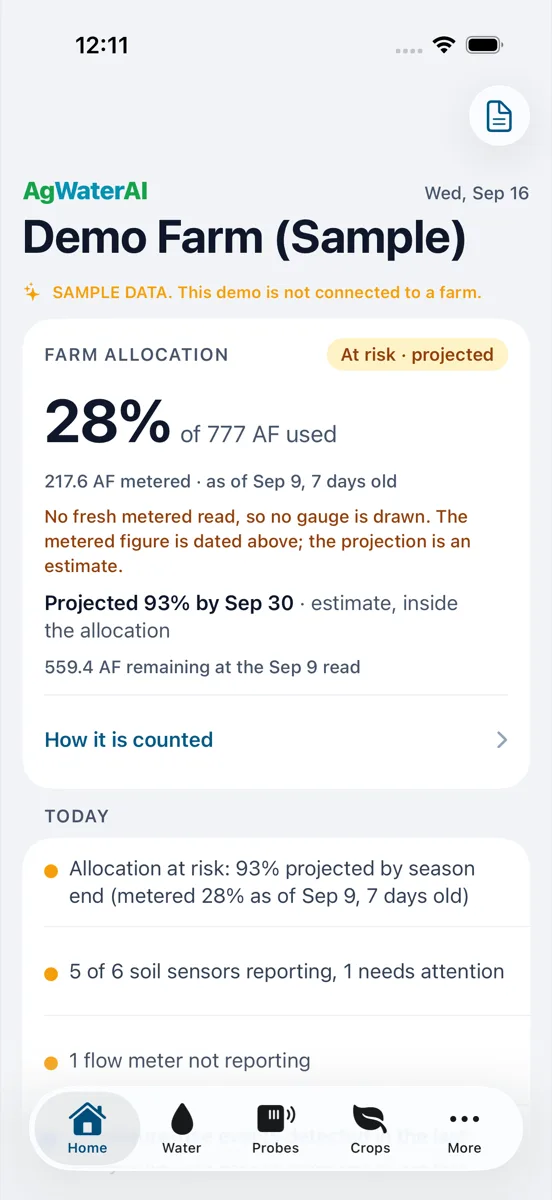
Your water position and field visits, on your phone.
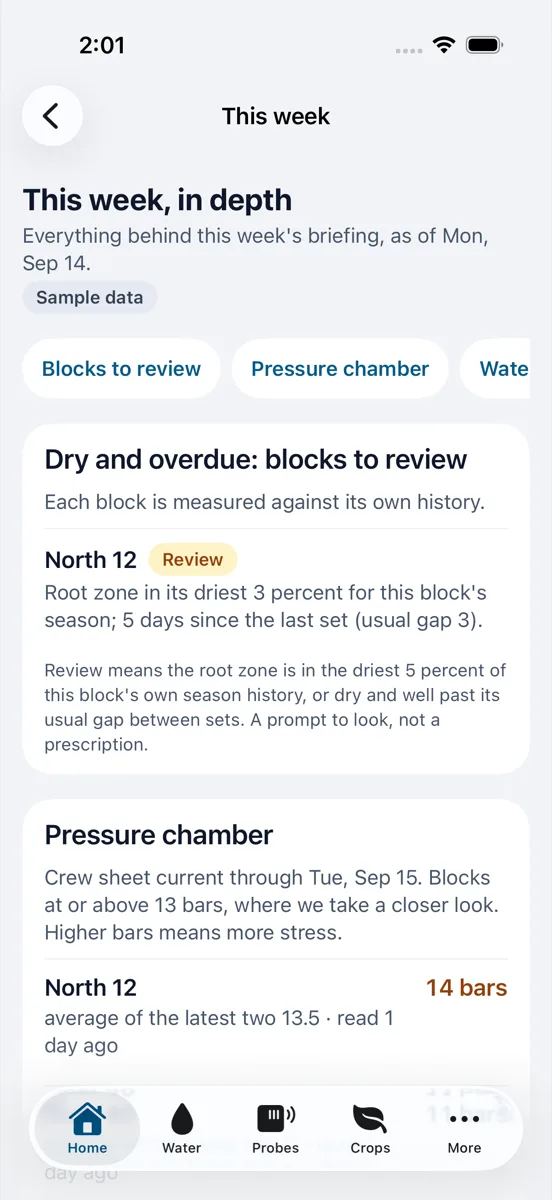
Growers see water used against the allocation, dated to the metered read, the blocks to look at before anything else, the pressure chamber history and the weekly record. The field team sees the visit queue and logs chamber readings by photo.
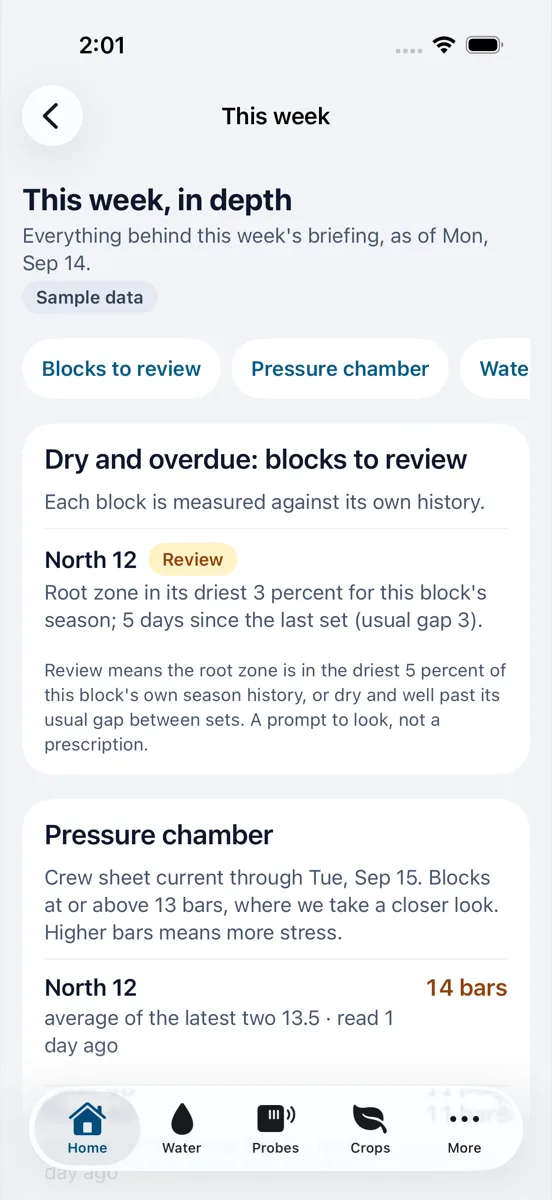
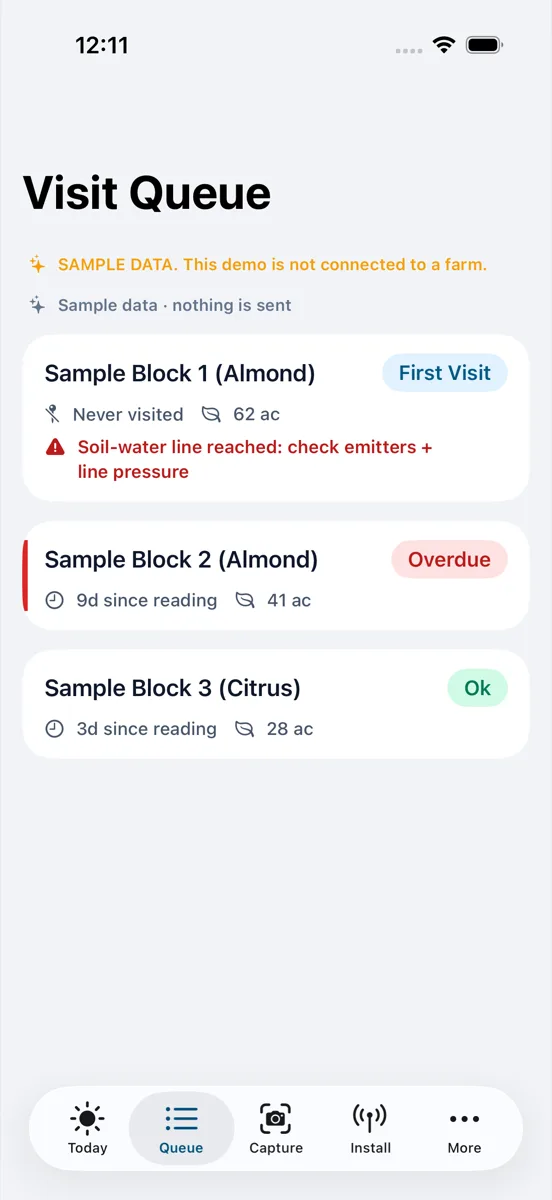

Follow a field visit, from the check in the orchard to the water order
Every screen shown is the app’s sample account, not a customer farm. Open the sample account before you sign in.
Built around readings taken in the orchard.
AgWaterAI grew out of a second-generation crop-advising practice that has worked Central Valley orchards since 1984. Every customer so far came through that practice.
- 6,500+
- 6,500+ pressure chamber readings since 2022, and 5,500+ of them on blocks with their own soil probe, matched to its readings and the weather (through Sep 30, 2026).
- 70 sites
- Daily soil data since 2016 on our oldest site; 70 instrumented sensor sites as of Aug 30, 2026.
Our stress models learn from our agronomist's pressure chamber readings in California permanent crops. You do not have to take chamber readings.
Your sensors or ours.
Platform
$20per acre per year
Use the probes you already own.
- Probes
- Yours: Sentek, METER, Irrometer, AquaSpy or other standard probes.
- Field work
- Your crew. Pressure chamber readings are optional.
- Order review
- You or your own adviser review and issue each order.
- Free for 90 days from when your probe data connects. No credit card.
- Then $20 per acre per year, 20-acre minimum. The paid plan starts on Day 91 unless you cancel in writing by Day 88.
- Sign up October through December 2026 and it stays free through March 31, 2027: the paid plan starts April 1, 2027 unless you cancel in writing by March 28, 2027.
- Full trial terms
Managed
$80per acre per year
Sensors, crew and agronomist included.
- Probes
- Ours, installed and calibrated.
- Field work
- Our crew, including the pressure chamber readings.
- Order review
- Our agronomist reviews and issues every order.
Managed service, cancellation and sensor deployment terms are set in your signed agreement.
Keep the readings behind your water decisions.
Your wells measure water at the pump. We keep the well side on the record: timestamped flow, cumulative acre-feet, monthly totals and any gaps flagged, with a reviewer code you can issue that opens the record for reading, in the form reviewers ask for; agency requirements differ.
- Measured or estimated, always labeled. A telemetry meter feeds it live; a dial meter by a monthly photo; no meter, a labeled estimate. The GSA's number is the official one.
- Missing readings named. Your dashboard and the iPhone app show each meter's last reading and name any meter that has gone more than a week without one.
- Reviewed orders and an export. Reading summaries are signed into a water-use record, tamper-evident from signing forward, and each issued water order is kept with the readings behind it. A reading sheet on the 1st comes as a CSV for your file and for the reviewer.
| Meter | Total AF | Days |
|---|---|---|
| Wells 1 to 4 are in series; the farm total is not the sum | ||
| Well 1 | 326.50 | 30 of 30 |
| Well 2 | 154.48 | 30 of 30 |
| Well 3 | 435.54 | 17 of 30 |
| Well 4 | 105.79 | 30 of 30 |
Well 3 reported 17 of 30 days: the sheet names the gap and the CSV export carries it.
Sample farm, sample numbers.
What we need to get started.
Which probes work?
Keep your Sentek, METER, Irrometer, AquaSpy or other standard probes. IrriMAX is self-serve. For other sensor brands our team checks feed access and handles the connection.
Which records do you need?
Your probe feed, your well-meter or pump records, and your GSA allocation. A telemetry meter feeds it live; a dial meter by a monthly photo; no meter, a labeled estimate. The GSA's number is the official one.
Who issues the water order?
On Platform, you do, or your own agronomist does: the draft comes to you and you issue it. On Managed, our agronomist reviews and issues every order. Either way the issued order is kept with the signed reading summaries behind it.
Can I keep my agronomist or PCA?
Yes. Keep your agronomist and your sensors. On Platform the Thursday draft goes to you or your agronomist, and whoever you choose reviews it and issues it; we never issue an order on your farm. The probes add what a field walk cannot see: cold roots, salt at the root zone and drying below the surface.
Who handles support?
On Platform, email support@agwaterai.com and a person on our team answers. On Managed, our agronomist and crew handle it, the same people who take your readings and issue your orders, and Ask an agronomist in the app is included: your question goes to your agronomist and the reply comes back in the app.
What works on day one?
Each part starts when its own records connect. The allocation view starts when your meter or pump records connect: a telemetry meter feeds it live, a dial meter by a monthly photo, and with no meter it shows a labeled estimate. Probe checks start when your probes connect: a probe that stops reporting or reports error values is flagged for review. The Thursday draft order runs on a physics water balance from your probes, pump and CIMIS. The missed-set alert starts once a block has a few weeks of its own pump records (a pump switch or a per-block meter), and the dry-and-overdue alert once a block has a season of probe history. Pressure chamber readings are optional; when you or your adviser take them, each one is judged against its block's stress line, and stress calls use your farm's own readings and build with its history.
How does the free trial end?
Platform, on your existing probes: free for 90 days from when your probe data connects. Sign up October through December and it stays free through March 31. Then $20 per acre per year, 20-acre minimum: the paid plan starts on Day 91 (or April 1) unless you cancel in writing by Day 88 (or March 28 for winter sign-ups). No credit card. After the Platform trial converts, cancellation takes effect at the end of your current billing quarter.
Who owns my sensor data?
Your raw sensor data belongs to you. We do not sell raw or identifiable farm data.