
See a sample briefing and water order.
You already have sensors in the dirt. For $20 per acre per year we read them and send your team the six things below. No new hardware.
Sample data Illustrative sample for a fictional “Sample Orchard Co.” No real grower’s farm, blocks or numbers appear here.
Written for a CCA.
The Monday briefing lists the blocks and readings your adviser should review.
Scout is the language model that writes the summary, and it never enters the irrigation decision. It is built to quote only numbers from your own sensor record. Three trained models run every week: two estimate crop stress, trained on our own stem water potential (SWP) readings matched to soil probes and weather, and one estimates the hours each block’s pump ran, from probes, weather and pump records. The stress models have not beaten the simple rules a grower already has, such as the block’s latest SWP reading. The Thursday draft water order comes from rules mined from our agronomist’s past orders for each block; it does not read that week’s weather, sensor data or any model. On Platform, your own Certified Crop Adviser or adviser makes the call. On Managed, our Certified Crop Adviser does. Your field readings help your adviser review those estimates; each stem water potential (SWP) reading is judged against its block’s stress line.
The Monday list needs a season of the farm’s own SWP readings. A farm with no readings does not get it.
A trained model projects each probe’s soil moisture three days ahead if no irrigation or rain occurs. For probes with their own history, on a farm it was never fitted on, it was closer three days ahead than assuming the soil stays where it is and than every other plain rule tested: about seven tenths of the best one’s miss. For a brand-new probe a plain rule does as well or better. Tested in periods when the probe saw no wetting, on one farm and one probe make, on past data that had been scored before. With that farm’s locations weighted equally, the model’s lead over the best plain rule is not clear. With irrigated periods removed the lead held; most remaining periods could not be checked, and on checked dry ones it is unclear. The next check, on new days, is scored November 23, 2026. A projection, not a call to irrigate.
Sample Orchard Co. · Central Valley, CA
Three straight days at 108°F or hotter, Sun Aug 2 to Tue Aug 4, peaking 114°F. Plan sets and crew timing ahead of it.
- Check North Pistachio Blk 1 · probe silent for 2d 20h
- Follow the adviser's reviewed order for South Navel Blk 4 · last read 20%
- Check River Block Almond sensor · no data 3d 8h
North Pistachio Blk 1 has not reported for 2d 20h. Check the block before changing its set. South Navel Blk 4 last read 20%; follow the adviser's reviewed order ahead of the Aug 2 to 4 heat.
Following this week’s reviewed water order.
66% of allocation used YTD, estimated from pump runtime
One week, scored.
One block, one week, start to finish: the reading, the draft from the adviser’s rules, the adviser’s call, the issued order, what the crew ran, the next reading and the score. Each step is kept, so the week can be checked later.
- 1. Mon Aug 3
The reading on Monday’s list
Read-first list: rank 3. Last SWP reading, Fri Jul 31: 12.5 bars, block line 14. Measured
- 2. Thu Aug 6
Draft from adviser rules
Draft order: 18 hours, two sets, from rules mined from the adviser’s past orders. Estimated
- 3. Thu Aug 6
The adviser’s call
The adviser changed it to 24 hours after the heat the Monday briefing flagged. Approved Thu 4:12 PM.
- 4. Thu Aug 6
The issued order
24 hours, two sets, issued Thursday. Kept with the readings behind it. The order itself is not signed.
- 5. Sat Aug 8 and Sun Aug 9
What ran
Crew logged 22 hours Sat and Sun. One set cut short for a pump fault, logged in the app. Crew log
- 6. Fri Aug 14
The next reading
SWP reading, Fri Aug 14: 13.0 bars, inside the line. Measured
- 7. Fri Aug 14
The score
Ledger: order followed with a logged deviation. Stress held inside the line. Block-week complete.
The ledger is being built to score every block-week on a customer farm against the next reading, in a row like this. A row counts only when it has the order, what ran and the next reading.
Sample farm, sample numbers. The structure is the real one.
Add your team
Techs join by magic link and see only their assigned ranches.
Assign by urgency
The queue brings each block’s recent field readings and flags together for your adviser to review, using the same alerts as the record.
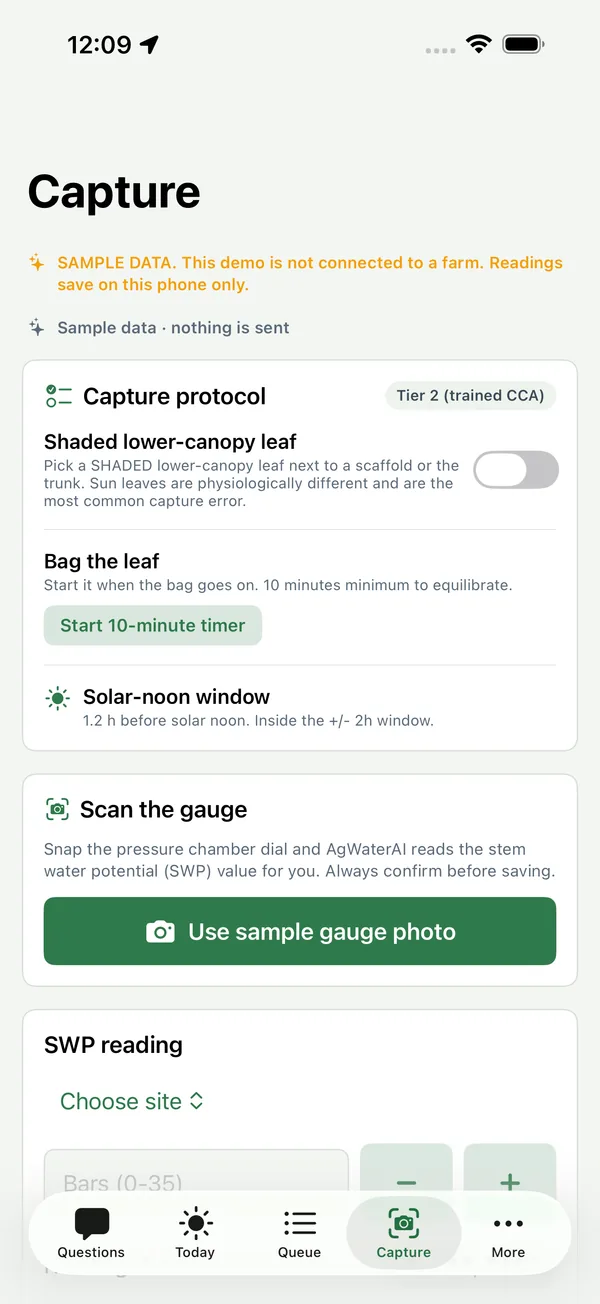
Capture in the field
Techs log SWP readings, gauge photos and set changes from the orchard, offline if needed. Your adviser can review each field reading beside the draft water order.
 Sample data
One weekly decision, layer by layer
The Thursday draft water order comes from rules mined from our agronomist’s past orders for each block; it does not read that week’s weather, sensor data or any model. A Thursday draft needs our agronomist’s past water orders for each block loaded into its rules, so a farm without them does not get one, and it gives numbers only for the months those orders cover. A farm without them starts with the Monday briefing on its probes, the soil projection on each probe once the probe has logged a wetting, and the sealed record where daily sealing runs. Your adviser checks the draft against the sensor record, forecast ETo and your allocation.
On Platform, your own Certified Crop Adviser or adviser reviews the draft and makes the call. On Managed, our Certified Crop Adviser reviews the draft and makes the call.
Model outputs are estimates; the reviewed order is the one that counts. Nothing we send controls a pump or a valve.
- 1. Field readings
SWP reading 12.5 bars, Friday.
Logged by the crew with a photo. The block’s soil probe at 24 in. is drying toward its line; CIMIS weather for the week ahead.
- 2. Draft order
Draft: 2 sets, 12 pump hours, Monday and Thursday.
Drafted from rules mined from our agronomist’s past water orders, on the blocks whose orders are loaded into those rules; it does not read that week’s readings. Our trained models add stress estimates for the adviser to weigh. The stress models have not beaten the simple rules a grower already has, such as the block’s latest SWP reading.
- 3. Your adviser
Reviewed by the adviser.
The adviser makes the call: approve, change or hold.
- 4. On the record
Signed and tamper-evident.
Probe readings are sealed into a signed, tamper-evident chain once each logger day closes, on the sites where daily sealing runs today. Well-meter readings that reach us through telemetry are sealed into a signed, tamper-evident chain as they arrive, checked every 10 minutes. Today that chain is separate from the probe chain, and a meter outside the telemetry feed is not sealed. Each issued water order is kept with the readings behind it; the order itself is not signed. Patent-pending.
The dashboard
Water use against the allocation, the blocks to review and the latest readings, on a sample farm. Every water figure says whether it is measured or estimated.
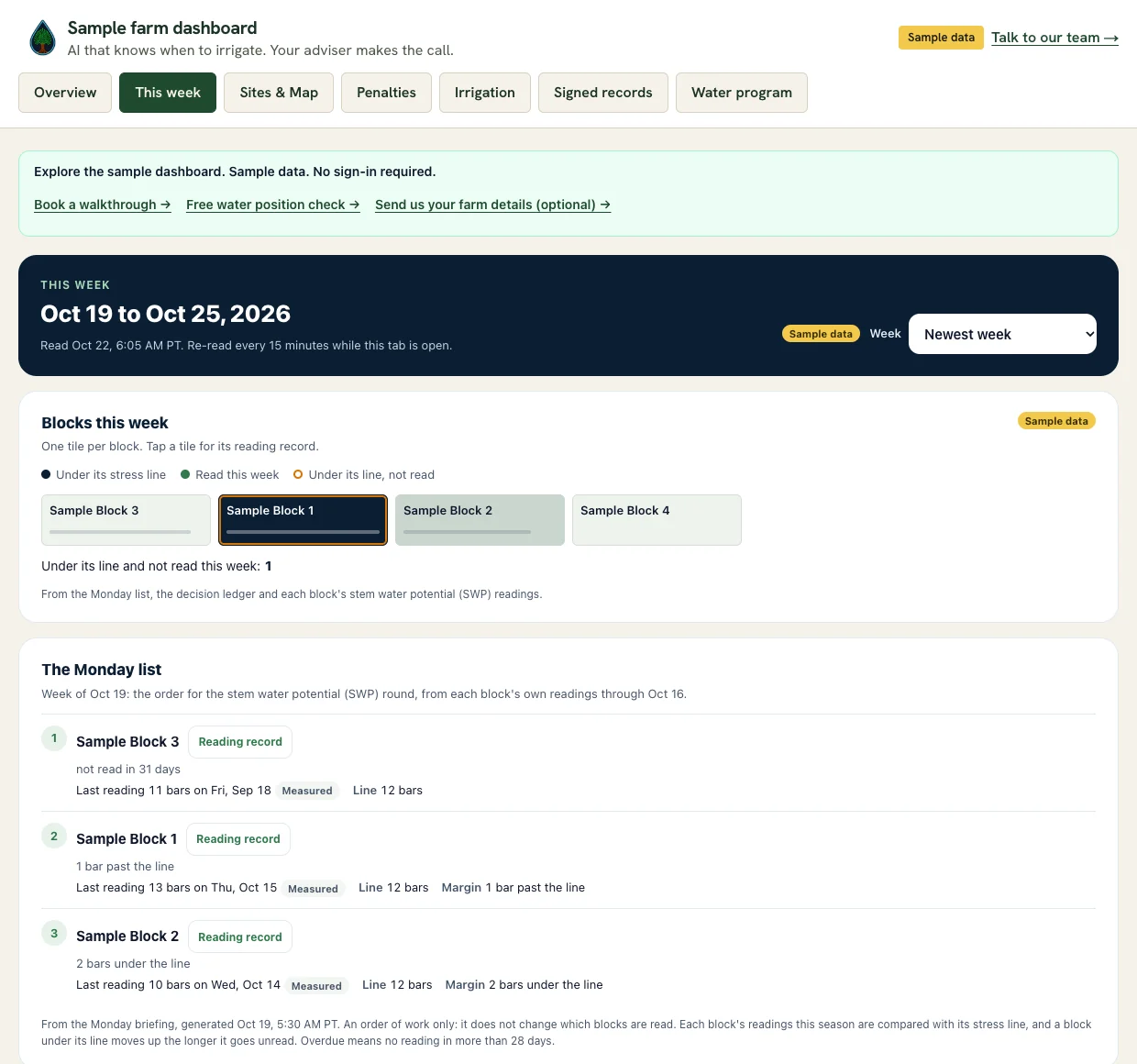
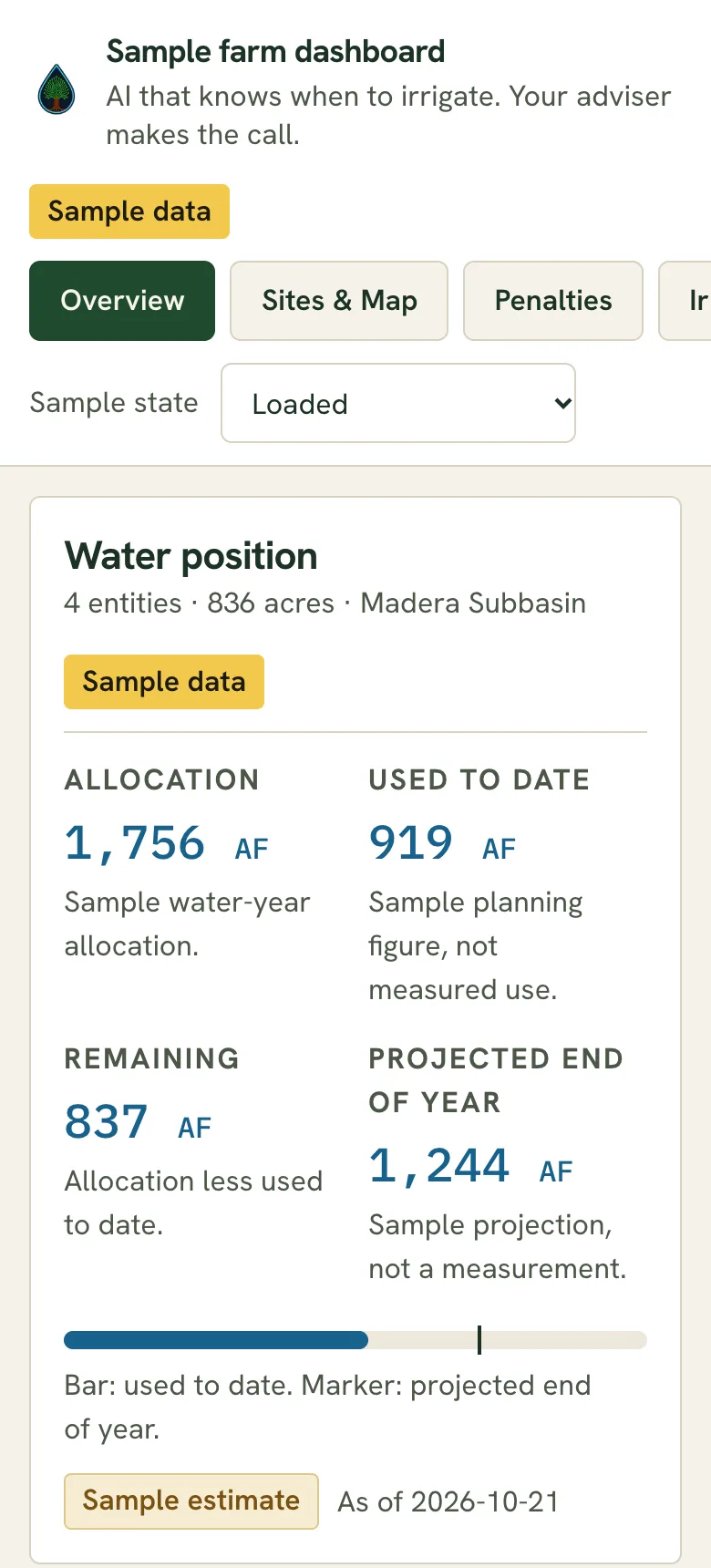
Sample data Sample farm, sample numbers. Nothing in the screenshot is a live measurement from a farm. Open the sample dashboard
See which probes are reporting and which need checking.
Each morning we read every logger’s last reading time. Within about 26 hours is healthy; otherwise it is silent. Loggers dark over a month are excluded as decommissioned.
Probe readings are sealed into a signed, tamper-evident chain once each logger day closes, on the sites where daily sealing runs today. Well-meter readings that reach us through telemetry are sealed into a signed, tamper-evident chain as they arrive, checked every 10 minutes. Today that chain is separate from the probe chain, and a meter outside the telemetry feed is not sealed. Each issued water order is kept with the readings behind it; the order itself is not signed. On the pilot farms, the draft order is logged before the adviser makes the call. No unit record has been issued under the groundwater program. The signing method is patent-pending.
Limits: tamper-evident records preserve signed reading summaries. They do not by themselves establish measurement accuracy, water savings or regulatory compliance. No credit volume, price or revenue is established.
Platform is $20 per acre per year
on your own probes, with your own crew and adviser. 20-acre minimum.
- The trial converts to the paid plan unless you cancel in writing before your free period ends.
- Platform, on your existing probes: free for 90 days from when your probe data connects. Then $20 per acre per year, 20-acre minimum. The paid plan starts the day after your free period ends unless you cancel in writing before it ends. For October to December signups, the free period ends on March 31 or 90 days after your probes start sending usable data, whichever is later.
- No credit card.
- After the Platform trial converts, cancellation takes effect at the end of your current billing quarter.
- IrriMAX is self-serve: paste your key and we pull your sites. For other brands, our team handles the connection.
Managed is $80 per acre per year
sensors, install and field service by our CCA-led team under a signed agreement.
Questions: info@agwaterai.com
Questions before you start
Which probes work?
Keep your Sentek, METER, Irrometer, AquaSpy or other standard probes, after we confirm access to their data. IrriMAX is self-serve. For other sensor brands our team checks feed access and handles the connection.
Which records do you need?
Your probe feed, your well-meter or pump records, and your GSA allocation. A telemetry meter feeds it live; a dial meter by a monthly photo; no meter, a labeled estimate. The GSA's number is the official one.
Who makes the call on the water order?
On Platform, your own Certified Crop Adviser or adviser reviews the draft and makes the call. On Managed, our Certified Crop Adviser reviews the draft and makes the call. Each issued water order is kept with the readings behind it; the order itself is not signed.
Can I keep my agronomist or PCA?
Yes. Keep your own probes and adviser on Platform. Your adviser reviews the week’s records, and the Thursday draft where our agronomist’s past orders for a block are loaded into the draft’s rules, and makes the irrigation call; we never issue an order on your farm. The probes add what a field walk cannot see: cold roots, salt at the root zone and drying below the surface.
Who handles support?
On Platform, email info@agwaterai.com and a person on our team answers. On Managed, our agronomist and crew handle it, the same people who take your readings and make the call on your orders, and Ask an agronomist in the app is included: your question goes to your agronomist and the reply comes back in the app.
What works on day one?
Each feature starts when its required records connect. The allocation view starts when your meter or pump records connect: a telemetry meter feeds it live, a dial meter by a monthly photo, and with no meter it shows a labeled estimate. Probe checks start when your probes connect: a probe that stops reporting or reports error values is flagged for review. Three trained models run every week. Two estimate crop stress and one estimates the hours each block’s pump ran. The stress models have not beaten the simple rules a grower already has, such as the block’s latest SWP reading. The Thursday draft water order comes from rules mined from our agronomist’s past orders for each block; it does not read that week’s weather, sensor data or any model. On Platform, your own Certified Crop Adviser or adviser makes the call. On Managed, our Certified Crop Adviser does. The missed-set alert starts once a block has a few weeks of its own pump records (a pump switch or a per-block meter), and the dry-and-overdue alert once a block has a season of probe history. SWP readings add direct evidence of tree water status; each one is judged against its block's stress line.
How does the free trial end?
Platform, on your existing probes: free for 90 days from when your probe data connects. Then $20 per acre per year, 20-acre minimum. The paid plan starts the day after your free period ends unless you cancel in writing before it ends. For October to December signups, the free period ends on March 31 or 90 days after your probes start sending usable data, whichever is later. No credit card. After the Platform trial converts, cancellation takes effect at the end of your current billing quarter.
Who owns my sensor data?
Your raw sensor data belongs to you. We do not sell raw or identifiable farm data.